
In a university setting, students arrive with diverse learning needs, ranging from specific learning differences like autism or dyslexia to varying physical and mental health conditions. Rather than waiting for students to encounter obstacles, we can design courses to be supportive and accessible from day one.
Use the checklist below to evaluate your current teaching practices and track your progress.
Inclusive Curriculum Design Principles
Questions to support inclusive thinking and planning.
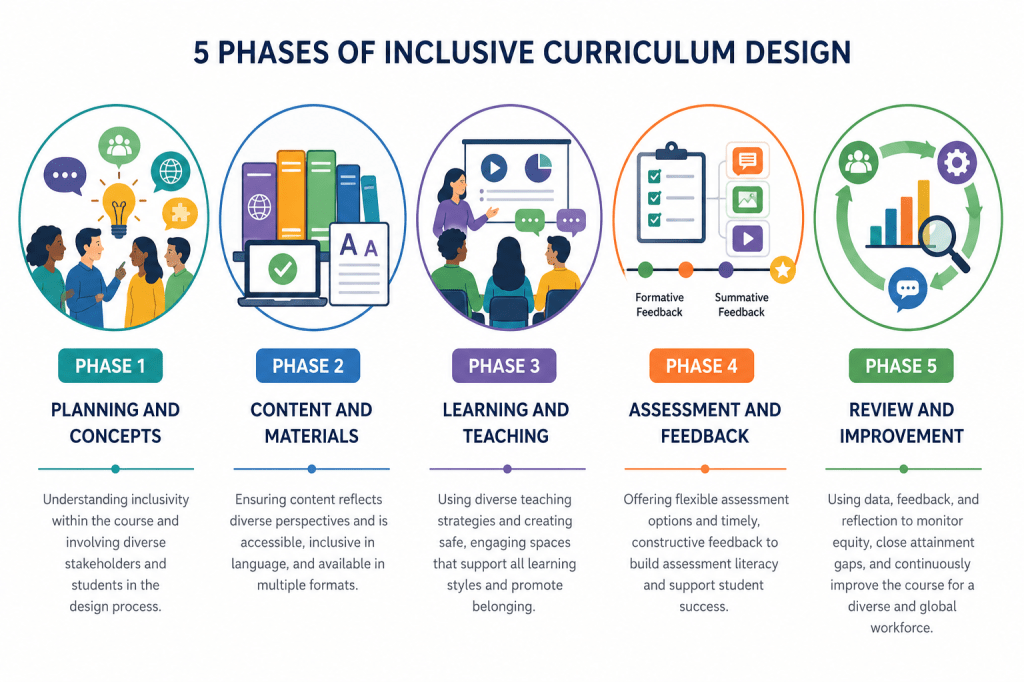
- Phase 1: Planning and Concepts
- How is inclusivity understood in relation to this specific course?
- How has the “hidden curriculum” (unwritten rules) been addressed?
- How have you involved students in the creation of the course?
- Phase 2: Content and Materials
- Do reading lists and case studies reflect the diversity of the learning community?
- Is inclusive language used, avoiding colloquialisms while providing a glossary for complex terms?
- How does the content enable students to recognise their potential in an evolving international context?
- Phase 3: Learning and Teaching
- How will the delivery engage different learning styles and provide alternative access options?
- What structured opportunities exist for cross-cultural interaction?
- How has unconscious bias and equality training influenced your approach?
- Phase 4: Assessment and Feedback
- How are students helped to develop “assessment literacy” and understand their feedback?
- How are you addressing “social distance” (the fact that some students feel less confident approaching staff)?
- Do assessments allow students to draw on their own backgrounds or apply principles to familiar contexts?
- Phase 5: Review and Continuous Improvement
- How will differential attainment (gaps in grades between groups) be monitored?
- How will you ensure students from diverse backgrounds are involved in the review and evaluation process?
- How will you utilize alumni to review how well the module prepared them for a global workforce?
- References
- Durham Centre for Academic Development (2026) Inclusive learning design. Durham University. Available at: https://dcad-resourcebank.webspace.durham.ac.uk/category/inclusive-learning/
- Cambridge Centre for Teaching and Learning (2026a) Inclusive assessment and feedback. University of Cambridge. Available at: https://www.cctl.cam.ac.uk/mind-gap-toolkit/what-works/examples/assessment
- Cambridge Centre for Teaching and Learning (2026b) Inclusive curriculum design. University of Cambridge. Available at: https://www.cctl.cam.ac.uk/mind-gap-toolkit/what-works/examples/curriculum
- Kingston University London (2025) Inclusive curriculum. Available at: https://www.kingston.ac.uk/experience/equality-diversity-and-inclusion/inclusive-curriculum
- Cambridge Centre for Teaching and Learning (2026c) Inclusive teaching practices. University of Cambridge. Available at: https://www.cctl.cam.ac.uk/mind-gap-toolkit/what-works/examples/teaching
 Fostering Digital Inclusion in Higher Education